In brief
The impact of U.S. tariffs has led to significant declines in major Asian stock indexes, prompting warnings of a potential economic slowdown.
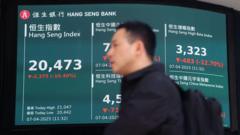
Asian stock markets are facing dramatic declines as the ripple effects of U.S. tariffs shake the financial landscape. When trading opened on Monday, major indexes from Shanghai to Tokyo, Sydney, and Hong Kong dropped sharply, leading analysts to describe the situation as a "bloodbath."The implementation of tariffs by U.S. President Donald Trump has particularly affected Asian countries, which are heavily reliant on exports to the U.S. market. With investors anxious about the potential for a global trade recession, indices like Japan's Nikkei 225 fell by 6%, while Australia's ASX 200 and South Korea's Kospi sank by approximately 4%.In mainland China, the Shanghai Composite index plummeted over 6%, and Hong Kong's Hang Seng Index fell by around 10%. Analysts, including Julia Lee from FTSE Russell, noted that rising inflation expectations and fears of a recession are fueling uncertainty. Goldman Sachs has even raised the likelihood of a U.S. recession to 45% within a year, with JPMorgan estimating a 60% chance of a downturn for both the U.S. and global economies.Asian economies, particularly Vietnam and Bangladesh, could face severe repercussions, as they export significant amounts of goods to the U.S. Tariffs of 46% on Vietnam and 37% on Bangladesh have made many brands nervous, including industry giants such as Nike. As global stock markets continue to slide, with U.S. indexes experiencing their worst week since 2020, the future remains uncertain for the Asian economic landscape. The wave of tariffs has prompted fears that the turmoil will lead to long-term challenges for smaller economies in the region that depend heavily on exports to the U.S. Realignment in trade relations appears vital, but experts warn that the impacts of the current tariff regime could linger.