In brief
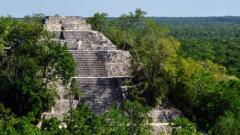
In a stunning archaeological breakthrough, a PhD student stumbled upon the lost Mayan city named Valeriana hidden under the Mexican jungle. This complex, featuring unique structures like pyramids and sports fields, challenges perceptions of ancient civilizations in the tropics.
In a remarkable twist of fate, a PhD student named Luke Auld-Thomas made a groundbreaking discovery while searching online: a buried ancient city, later named Valeriana, in the dense jungles of Campeche, Mexico. Unveiled through Lidar technology, which maps structures beneath vegetation with laser surveys, the site includes pyramids, residential areas, and sports fields, suggesting a vibrant urban center that flourished between 750 and 850 AD, likely hosting up to 50,000 inhabitants.Auld-Thomas, a researcher from Tulane University, found the data while perusing online surveys. With the aid of Lidar, which uses laser pulses to reveal hidden objects, he uncovered what many had overlooked. The findings not only highlight the intricate architecture of the ancient Maya but also challenge the long-held belief that tropical regions were less conducive to thriving civilizations. The city of Valeriana, covering 16.6 square kilometers, includes distinctive plaza areas, temple pyramids, and even evidence of sports courts where ancient ball games took place. The team’s exploration revealed over 6,700 structures and signs of significant population support systems, indicating a well-organized community. Experts speculate that factors including climate change may have contributed to the city’s eventual decline around 800 AD, alongside the arrival of Spanish colonizers centuries later. The application of Lidar technology is revolutionizing archaeological methods, offering new opportunities to locate other sites concealed by nature. As excavations continue across Mesoamerica, researchers are realizing the vast potential to uncover more of the region’s rich history—a journey that will shed light on the complex lives of the ancient Maya.The study has been published in the academic journal Antiquity, and it underscores the ongoing mystery of ancient civilizations and their interactions with their environments.