In brief
Amid Trump’s renewed tariff threats against China, Beijing aims to project calm while exploring opportunities to enhance its global standing, leveraging the uncertainty in US foreign relations.
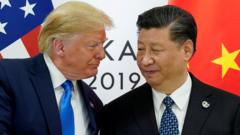
As the trade landscape shifts yet again with Donald Trump’s imposition of an additional 10% tariff on Chinese goods, China has opted for a surprisingly muted response. In previous trade wars, Beijing vocally challenged US actions, but this time, it has held back its ire, perhaps hoping for negotiations. While Canada and Mexico have aggressively retaliated against Trump’s trade policies, China appears to be adopting a strategic wait-and-see approach.Trump’s first term marked turbulent trade relations between the US and China, but Beijing now feels less dependent on American dealings thanks to diversified trade partnerships across Africa, South America, and Southeast Asia. Analysts suggest that the newly introduced tariffs might not pack the punch Trump is seeking, and as Chong Ja Ian of Carnegie China points out, the Chinese government seems willing to endure this latest pressure.Moreover, President Xi Jinping may view these trade tensions as an opportunity to solidify his vision of China stepping into a global leadership role, particularly as the US grapples with uncertainty under Trump’s policies. In contrast to Trump’s “America First” stance, Xi has promoted a narrative of “win-win” globalization, aiming to attract nations unsure of their standing with Washington. Chinese investments have surged in countries like Cambodia, which have become notable destinations for Chinese enterprises looking to navigate US-imposed tariffs. While Trump’s policies signal a withdrawal of US influence, Xi appears committed to filling that vacuum, bolstering international relationships and pledging support for global initiatives such as the World Bank and climate accords.As the South China Sea stirs concerns among neighboring countries about potential Chinese assertiveness, a reevaluation of alliances is underway. Countries like Japan, South Korea, and Australia may pivot toward closer cooperation in response to perceived threats from both China and an unpredictable US.China’s calm demeanor in the face of new tariffs also comes during a festive time, while government officials remain hopeful for renewed dialogue to ease tensions. However, experts warn that the unpredictability of the Trump administration, coupled with a growing bipartisan consensus in the US that views China as a significant threat, could soon escalate conflicts in bilateral relations.Ultimately, while China aims to maintain stability and explore opportunities for greater global influence, the future of US-China relations remains uncertain, hinging on the political tides and Trump’s distinct approach to international trade.