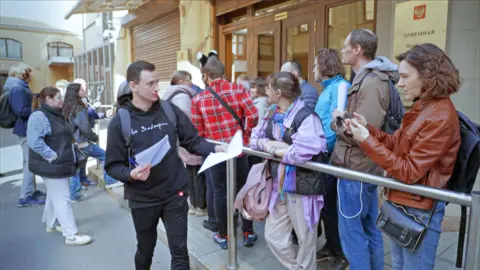
Near the Kremlin, dozens queue outside the presidential administration, submitting petitions that call on President Vladimir Putin to end the ongoing crackdown on the internet. Increasing control over Russia's online environment has led to restrictions on global messaging apps and disruptions to mobile internet services. While the act of petitioning is legal, in an authoritarian state like Russia, it poses significant risks to those involved.
Citizens like Yulia, who owns a catering company rely heavily on the internet for conducting business. 'Every time there is a blocking of the internet, we lose money,' she states, illustrating the detrimental impact of the authorities' actions on small enterprises.
Despite official claims that these internet curbs are for public safety, many, including independent journalists and the public, perceive an emerging 'digital Iron Curtain.' While President Putin acknowledges these disruptions, he downplays any public discontent, asserting that the measures will be reassessed once the security situation improves.
Yet, discontent is rising among the population, particularly among small business owners and everyday citizens who struggle with constant internet disruptions impacting their daily lives.
Recent social media outcries, even from influencers, have echoed the frustrations of many Russians, emphasizing the growing divide between citizens and the government. As restrictions tighten, a wave of adaptation is ongoing among those affected, with many resigned to a grim future smattered with uncertainty.
Citizens like Yulia, who owns a catering company rely heavily on the internet for conducting business. 'Every time there is a blocking of the internet, we lose money,' she states, illustrating the detrimental impact of the authorities' actions on small enterprises.
Despite official claims that these internet curbs are for public safety, many, including independent journalists and the public, perceive an emerging 'digital Iron Curtain.' While President Putin acknowledges these disruptions, he downplays any public discontent, asserting that the measures will be reassessed once the security situation improves.
Yet, discontent is rising among the population, particularly among small business owners and everyday citizens who struggle with constant internet disruptions impacting their daily lives.
Recent social media outcries, even from influencers, have echoed the frustrations of many Russians, emphasizing the growing divide between citizens and the government. As restrictions tighten, a wave of adaptation is ongoing among those affected, with many resigned to a grim future smattered with uncertainty.