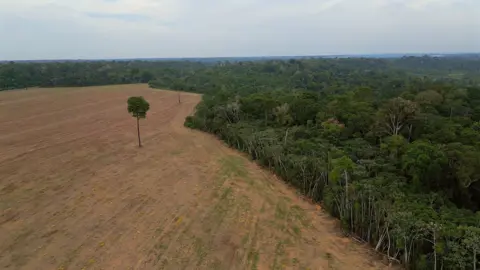
The Amazon rainforest could face a renewed surge of deforestation as efforts grow to overturn a long-standing ban that has protected it. The ban - which prohibits the sale of soya grown on land cleared after 2008 - is widely credited with curbing deforestation and has been held up as a global environmental success story. But powerful farming interests in Brazil, backed by a group of Brazilian politicians, are pushing to lift the restrictions as the COP30 UN climate conference enters its second week. Critics of the ban say it is an unfair 'cartel' which allows a small group of powerful companies to dominate the Amazon's soya trade.
Environmental groups have warned removing the ban would be 'disaster', opening the way for a new wave of land grabbing to plant more soya in the world's largest rainforest. Scientists say ongoing deforestation, combined with the effects of climate change, is already driving the Amazon towards a potential 'tipping point' – a threshold beyond which the rainforest can no longer sustain itself.
Brazil is the world's largest producer of soya beans, an important animal feed that supports food supply chains in countries like the UK. Major UK food companies support the Amazon Soy Moratorium to keep their supply chains free from deforestation. Despite this, there are calls from within Brazil to lift the ban, posing a major risk to the Amazon's future and global ecological balance.
Environmental groups have warned removing the ban would be 'disaster', opening the way for a new wave of land grabbing to plant more soya in the world's largest rainforest. Scientists say ongoing deforestation, combined with the effects of climate change, is already driving the Amazon towards a potential 'tipping point' – a threshold beyond which the rainforest can no longer sustain itself.
Brazil is the world's largest producer of soya beans, an important animal feed that supports food supply chains in countries like the UK. Major UK food companies support the Amazon Soy Moratorium to keep their supply chains free from deforestation. Despite this, there are calls from within Brazil to lift the ban, posing a major risk to the Amazon's future and global ecological balance.